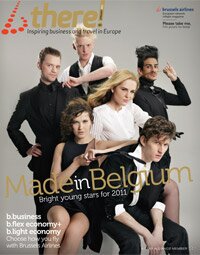
bthere inflight magazine of brussels airlines
Welcome to the Inflight Magazine of Brussels Airlines
The Categories

Q&A

Joaquín Cortés

Interview Tabitha Lasley

Hot-blooded flamenco dancer Joaquín Cortés began his career with Spain’s National Ballet, but it was his 1995 show ‘Gypsy Passion’ that made him a star. Since then, the Córdoba native has danced all over the world and is currently touring Europe with his show ‘Mi Soledad’

01 What first got you into dancing?

I grew up in a gypsy family and we were surrounded by flamenco music and dance. All family gatherings are like this. Early on, my uncle, Cristobal Reyes, encouraged me to take dancing seriously and made me realise the discipline that would be necessary in order to make a career from it.

02 Where’s the best place to eat in Madrid?

Madrid is full of great places to eat and drink. I think I read that there are more bars in Madrid than any other city, person for person. You can get great food in nearly all of the bars and the custom of tapas is a wonderful way to combine the two things. My favourite restaurant is Come Prima (Calle Echegaray 27, tel. +34 91 420 30 42) in the old centre of Madrid.

03 Where’s the best place to drink in Madrid?

Madrid is an incredibly social city and a lot of life takes place in the bars and on the streets. The best is Chicote (Gran Vía 12).

04 Where in Madrid do you go to get away from it all?

When I am in Madrid, I tend to be surrounded by my family and that is what gets me away from it all more than anything else. After all the travelling I have to do, it is my best form of unwinding.

05 Where would you go in Madrid to soak up some culture?

It depends. If I wanted to see flamenco, then, probably, Casa Patas (Cañizares 10, tel. +34 91 369 04 96), which has live shows nearly every night. If I wanted to go to a museum, then Madrid has three of the best art galleries in the world – the Museo del Prado (Paseo del Prado, tel. +34 91 330 28 00), the Museo Thyssen (Paseo del Prado 8 tel. +34 91 369 01
51) and the Museo Reina Sophia (Calle Santa Isabel 52, tel. +34 91 774 10 00).

06 Where would you go out in Madrid if you wanted to dance?

I dance all over the world, so the last thing I want to do is to go out to dance, unless I am performing there in a theatre.

07 Where would you go in Madrid for a great view of the area?

The Plaza del Oriente, where the royal palace is, has some fabulous views of the mountains to the north and the west of Madrid.

08 You’re originally from Córdoba, but moved to Madrid when you were 12. How do the two cities compare to each other?

They are very different. Madrid is a capital city, while Córdoba is a provincial capital, so it’s much smaller. I have family in both cities, so I visit Córdoba regularly. It has a different atmosphere; it is a real Andalucian city.

09 What advice would you give someone visiting Madrid for the weekend?

To enjoy themselves and just walk around the streets. That’s where the life is.

10 Which European cities have you particularly enjoyed visiting?

I am very fond of London – and the Royal Albert Hall is one of my favourite places to perform. I like Italy a lot. Rome is a great city, as is Milan.

11 You’ve recently been invited to the European Parliament as a representative of gypsy culture. What do you hope this partnership will achieve?

More than anything, this will be about the ability to communicate what it is possible for a gypsy to achieve in modern society. The most important thing is to give hope and aspiration to a group of people that are outside the mainstream of society. In the long term, whatever we can achieve – whether it’s educational objectives or showing the positive side of the gypsy culture – will be a tremendous bonus. Ultimately, this is about the integration of a culture through the process of education.

12 You made your screen debut in Pedro Almodóvar’s The Flower of my Secret. Do you have any more plans to act in the near future?

I have acted in a number of films since then. I starred in a Spanish production called Gitano, along with Letitia Casta, and I also had a major film in Italy called Vanilla and Chocolate. I am always interested in good films and I like the process of making them. Acting is something that I really enjoy.

13 How do you cope with stage fright?

I don’t really suffer from stage fright. If I am approaching the premiere of a new show, then there will be so much work involved in making sure all of the details are right that there is no time to be nervous. Of course, the nerves will creep in and there is a lot of stress at such times. But, as soon as I get on stage, I forget everything and become totally focused on what I have to do. The act of dancing and the enjoyment I get from performing is liberating; all stage fright vanishes at this point.

14 What dance would you like to learn and which novice would you most like to dance with?

If I see any type of dance I like, I try to incorporate it into what I do. My shows have always developed in this way, mainly because I trained in classical dance with the Spanish National Ballet.

I have never really danced pure flamenco
– I have always tried to create a ‘fusion’. I also like tap, though it is really quite similar to the taconeo of flamenco.

15 Which other dancers do you admire?

My idol was always Rudolf Nureyev.

16 What are you working on at the moment?

I am touring with my show ‘Mi Soledad’ this summer and we will have shows all over Europe after an initial run in Madrid. I also want to debut the show in a Broadway theatre and we are working on making this happen at the moment.

17 What is your motto?

I don’t have one.

Print This Post Print This Post   Email This Post Email This Post

Latest posts from: incoming

No Comments »

No comments yet.

RSS feed for comments on this post. TrackBack URI

Leave a comment


© Ink Publishing 2008. All Rights Reserved.