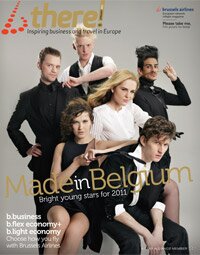
bthere inflight magazine of brussels airlines
Welcome to the Inflight Magazine of Brussels Airlines
The Categories

Business trends

Our round-up of what’s happening in the business world across Europe

Text Boyd Farrow
Image Corbis

RADAR
The price of beauty

Italy’s beauty industry is sobbing so much over the worsening euro-dollar exchange rate, its mascara is totally ruined. It emerged at the annual Cosmoprof trade fair in Bologna that Italian beauty exports increased only 1% in 2007, instead of the expected 5%.

Trade body Unipro says that, as its members cannot challenge the global players like L’Oréal head-on, they will have to play up the ‘Made in Italy’ banner to create a more sophisticated and competitive positioning for products. The strategy is to replicate what local Italian producers did in the fashion, auto and design industries. Nevertheless, the task looks daunting, given that the size of the entire Italian beauty industry stood at a little over €8bn for 2007 and L’Oréal’s turnover alone was €17bn.

Moreover, Italian women aren’t helping that much. The Italian beauty industry’s retail performance in its home market last year was just under €6bn, up only 2.3% on 2006. The channels that moved ahead were pharmacies, with 8.5% growth; perfumeries, up 3.3%; beauty salons, up 2.1%; and hairdressers, with a 1% increase. On the bright side, according to US giant Avon, which has just ramped up its international operations, sales of lipstick are supposed to shoot up in times of economic woe.

Upgrade your trip
SMOKE SIGNALS

Known the world over for its cigars and fragrances, Swiss company Davidoff is finally squeezing into the crowded watches, pens and luggage sector. The company’s new luxury brand, Very Zino, is named in memory of its founder, celebrated cigar aficionado Zino Davidoff. Unlike some licensed non-smoking products, the Very Zino range will be manufactured under the company’s direct control. Apparently this is: “To ensure that everything will meet the founder’s maxim: Pleasure in a thing of beauty is the essence of a happy life.” Whatever.

In 1980, the Zino Davidoff company was formed as a separate entity from the tobacco business, which is owned and run by the conglomerate Oettinger Imex. The aim was to build the Davidoff name into an international luxury brand like Dunhill. The Very Zino collection will include Swiss-made watches, leather luggage from Italy and German writing instruments. www.zinodavidoff.com

DRAWING BOARD
THE NUMBER’S UP

There are conflicting signals about the effect of the economic downturn on the top-end watch business. First comes Vacheron Constantin’s announcement that it has employed a passport printer and a Swiss banknote designer to develop new security features in its ongoing battle with those pesky counterfeiters. The Swiss watchmaker is now laser-engraving the words ‘Swiss Made’ and ‘Automatique’ on the dials, while laser-engraving with inking is used for the numerals, the calendar and the branding. vacheron-constantin.com

On the other hand, Swiss watchmaker Romain Jerome seems to have proved conclusively that there is more money than sense among top-end customers. Its Day&Night watch costs €190,000 but doesn’t actually tell the time, only whether it is night or day. The company claims that all of the limited-edition timepieces sold out within 48 hours of its launch. Romain Jerome says the watch was developed because 80% of people feel that time is the ultimate luxury and, it claims, 67% of people don’t actually use their watch to tell the time. www.romainjerome.ch

Not really… Bad news

Despite first-quarter earnings that met expectations – revenues up 28.4% year-on-year to €12.66bn, operating profits up 20% to €1.5bn – Nokia’s shares plunged 14% in Helsinki and New York. Why? Well, the phone company’s executives were ever so slightly pessimistic about the global economy, musing that the total value of the handset market could slip this year. Some analysts seized on the fact that Nokia’s average selling price for handsets continued its downward trend to just €80, about 10% less than a year earlier. Nokia’s global market share also slipped to 39.8% from a record 40.6% in the previous quarter. Nokia’s CEO Olli-Pekka Kallasvuo was even asked on a media conference call if food prices could hurt handset sales, a scenario he thought was “pretty remote”, calling the mobile phone “a necessity item”.

In fact, Nokia’s share of the world’s mobile phone market is greater than that of its next three rivals – Samsung, LG Electronics and crisis-ravaged Motorola – combined. And it has far more resources to develop highly profitable smartphones and internet businesses. “Many companies in our industry and some who have exited the market have struggled because of lack of scale. We expect this to continue and we continue to expect to benefit from our scale,” sighed Kallasvuo, probably wishing he could have focused more on the good news.

RADAR
AN ON-MESSAGE YARN

The latest clothing brand to jump aboard the eco-bandwagon is the venerable British knitwear purveyor John Smedley. The company has just launched a label, Luxury Redefined, with a long-sleeved T-shirt which it claims “sets new standards in sustainable product design and communication”.

Communication? Hacking through the inevitable forest of eco-blurb, it says of the Luxury Redefined T-shirts: “They are made in Derbyshire from organic, undyed, unbleached, fair trade, extra-long staple Peruvian cotton with an exceptionally low water footprint.” Attention has also been paid to minimising waste, energy and packaging. Every product comes with a mini-brochure [responsibly printed on 100% post-consumer waste paper in vegetable ink] that tells the story of exactly how the T-shirt was made. Ah, that’ll be the communication.

Naturally, such a planet-saving endeavour comes at a price. The men’s T-shirt costs a breath-robbing €148, while the women’s one costs €142. There is also a child’s size, but it’s still probably cheaper to sell out and go to Gap. www.johnsmedley.com

Why are we here?
BUYING MODERN ART IN RUSSIA

Russia’s economy has grown for nine consecutive years now, creating a pool of art collectors willing to spend lavishly. In 2007, Sotheby’s reported a 24% rise in Russian art sales to over €121m – a 31-fold increase since 2000, when it was €3.81m. But before this month, wealthy Russians have had to go abroad to buy international modern art. Now Volker Diehl, who has been promoting Russian contemporary art in Berlin for decades, has opened what he says is Moscow’s first internationally owned art gallery, Diehl + Gallery One. More intriguingly, the pristine white space on Smolenskaya Embankment has opened with an exhibition by US-based conceptual artist Jenny Holzer, who made her name in the 1970s with a series of quotes called Truisms, played across LED screens. Holzer says she wants to project something on Saint Basil’s Cathedral, Lenin’s Tomb and the Kremlin.

Moscow is rapidly becoming an international hub for contemporary art. Last year works by Damien Hirst, exhibited at the Triumph Gallery, were snapped up before the show opened. Jake and Dinos Chapman’s exhibition last December also drew large crowds. And Roman Abramovich’s girlfriend, Dasha Zhukova, has reportedly bought a space to open her own art gallery. The Chapman brothers are working on a new exhibit, featuring a silver and leather-bound Book of Revelation which will rest on a life-size skeleton. This will debut at the Triumph later this year.

Buzzing about…
What will LVMH buy next?

LVMH (Moët Hennessy Louis Vuitton), the world’s largest luxury conglomerate, is widely expected to take advantage of a downturn in the industry by hoovering up several rival brands. Last month LVMH agreed to buy Hublot, a Geneva-based watchmaker which it believes will fit well in its portfolio of brands such as TAG Heuer, Dior Montres and Chaumet. Hublot’s distribution network is so far limited to 300 stores worldwide, but LVMH said the brand, which has recently been launched in China and India, would have “a very significant increase in revenue” in 2008. Many believe that the Rome-based jeweller Bulgari is also a target for LVMH, even though the family company, valued at €2bn, insists it is not for sale. At the same time LVMH, whose more than 50 brands include Veuve Clicquot champagne, is known to be sniffing around some tequila and whisky labels. LVMH insists that overall growth will continue this year in spite of a “challenging monetary environment and an uncertain economic climate”. It has already raised the prices of champagne and luggage to combat the higher Euro. The company says US department-store sales are difficult, but that this is offset by European and Asian tourists in New York.

GROWING GAINS
Movies peel ahead

France Telecom’s mobile, internet, and TV unit Orange is to introduce a service this autumn that will let subscribers watch Warner Bros movies and HBO programmes on their PCs, TVs and mobile phones. France, already Europe’s video-on-demand leader, will be the first telco to offer the same content on all three platforms.

The service will debut in France, but Orange – also present in the UK, Spain, Poland, Switzerland, Slovakia Romania and Belgium (via subsidiary Mobistar) – plans to roll it out everywhere else soon afterwards. Other phone companies are expected to offer similar packages. ABI Research reckons seven million subscribers in Europe receive internet-based TV (IPTV) services via set-top boxes and the Orange deal illustrates how telcos are attempting to offset declining revenues from voice calls. Global IPTV revenues, says ABI, could top €10bn by 2011.

Understandably, Hollywood movie makers would rather sell content to legitimate providers than have it downloaded illegally. France Telecom recently won the right to broadcast live soccer while Orange is developing health-related services such as mobile blood-pressure monitoring. The latter might just come in useful if you’re watching a penalty shoot-out or the final episode of The Sopranos in a supermarket queue.

Traffic report
CARS STALL THROUGHOUT EUROPE

New car registrations in Europe plunged by nearly 10% in March, according to the European Automobile Manufacturers’ Association (ACEA), a worrying sign for the industry. Analysts interpreted the fall as a sign that consumers are putting off pricey purchases as the credit crunch bites. Most car giants – Fiat, Ford, GM, Peugeot and Volkswagen – have reported a dip in sales in the first quarter. Asian brands were the worst hit, with Toyota sales plunging 17% year on year and Hyundai 15%.

Sounding suspiciously like a drowning man clutching at straws, the ACEA attributed the sales slide partly to “this year’s early Easter holiday, which resulted in two fewer sales data processing days than in 2007.” Nevertheless, the upper end of the market continues at full throttle. BMW and Mercedes-Benz both notched up higher quarterly sales: 11% and 4.5% respectively. But the latter, which also makes the Smart car, reported a 1.8% fall in March registrations.

Print This Post Print This Post   Email This Post Email This Post

No Comments »

No comments yet.

RSS feed for comments on this post. TrackBack URI

Leave a comment


© Ink Publishing 2008. All Rights Reserved.